
Translating Science into Better Health for All
The UAB Minority Health & Health Equity Research Center (MHERC) generates and disseminates research knowledge from biomedical, behavioral, and social sciences in order to reduce the health disparities experienced by vulnerable populations and disadvantaged communities locally, regionally, and nationally.
The MHERC is built on three pillars: Research, Training, and Community Engagement. These pillars align with the University’s strategic goals and make it an enabling platform for UAB’s research, teaching, and service missions. Click below to learn more.


Community Engagement
Our partnerships, active in 12 Alabama counties and eight Birmingham neighborhoods, have created lasting and sustainable community capacity, empowering people to take charge of their own health.
-
 Live HealthSmart Alabama announces expansion into central Alabama with support from Novo Nordisk Inc.Through a generous gift from Novo Nordisk Inc., Live HealthSmart Alabama is beginning to expand statewide, starting in central Alabama with Selma, Demopolis and Camden, while taking steps to make good health simple — one person, one family and one community at a time.
 -
 Annual MHERC health equity symposium to highlight community engaged research strategiesThe University of Alabama at Birmingham’s Minority Health & Health Equity Research Center will hold its annual UAB Health Equity Research Symposium. The symposium highlights the work of undergraduate, graduate, post-doctoral and faculty investigators in clinical, behavioral, social, and community-based research related to health equity and health disparities.
 -
 MHERC Training Hosts 2024 Grant Writing Retreat with Health Equity Research Education Program (HEREP) ScholarsThe 2023-2024 Health Equity Research Education Program (HEREP) scholars recently participated in a three-day intensive Grant Writing Retreat at the Westin Hotel in Birmingham. This program, hosted by the UAB Minority Health & Health Equity Research Center (MHERC), provides scholars with a platform to present a grant proposal to senior investigators and experts in the field of health equity research.
 -
 The UAB Minority Health & Health Equity Research Center announces its first-ever Operations AdministratorFor over 20 years, the UAB Minority Health & Health Equity Research Center (MHERC) has generated and disseminated research findings to reduce the health disparities experienced by vulnerable populations across the nation. As MHERC teams continue to translate science into better health for all, leadership prepares to align the center for success in years to come.
 -
 Live HealthSmart Alabama launches Community Leadership Academy with inaugural cohortThe academy provides a forum where knowledge and skills are developed and refined to support community leaders as they conduct planning and improvement projects, balance needs and resources, and secure funding that ignites change.
 -
 Listening to Community Voices: UAB partners with local residents to improve cancer outcomesThe Community Advisory Board (CAB) for our new National Cancer Institute Center CARES (Cancer Awareness, Research, Engagement, and Support) is comprised of representatives from faith-based organizations, businesses, civic organizations, local healthcare providers, and residents, plays a pivotal role in of the mission of the project in enhancing cancer prevention, detection, diagnosis, treatment, and the overall well-being of cancer survivors.
 -
 Building Health and Community: The Impact of REACH Up and Out Program for African American Women in Alabama's Black BeltDeveloped by the University of Alabama at Birmingham’s Minority Health & Health Equity Research Center (MHERC), REACH Up and Out is a five-week program designed to provide African-American women with the knowledge, skills, and encouragement to eat healthy and engage in physical activity. More importantly, the program aims to build a social support network for African-American women, 18 and older, in Alabama and Mississippi who can help each other better take care of themselves and their health. With two successful implementations completed, we shed light on the enriching experiences of the women who have come together, forming friendships, and uniting in their shared commitment to a healthier life.
 -

-
 MHERC's Summer Training Programs Empower Future Healthcare ResearchersThe Minority Health & Health Equity Research Center (MHERC) is actively addressing the underrepresentation of minority researchers and healthcare professionals. Our training curriculum is strategically designed to attract and equip prospective researchers, guiding them from their undergraduate years through postdoctoral fellowships. This process establishes a continuous stream of dedicated researchers committed to achieving health equity. As we prepare to bid farewell to the summer season, we're delighted to provide a recap of some of our summer training initiatives.
 -
 Transforming Rural Healthcare: The Doc on the Spot Clinic's Impact on Accessible Care in Orrville, AlabamaWith over 570 visits since 2019, the Doc on the Spot Community Care Clinic has been a source of preventive healthcare for underinsured residents of Orrville, Alabama. As the program's current phase draws to a close, its impact for addressing healthcare disparities in rural areas is undeniable. Brenda Collins, an unwavering community liaison, has been a constant and reassuring figure, extending her assistance and support. Collins’ commitment shines as she shares, "Our community flourishes when we help each other; I’m passionate about encouraging others and showing acts of kindness to the patients.”
 -
 The UAB & UTHSC Emotional Well-Being & Economic Burden (EMOT-ECON) Research Network hosts 2nd Annual Scientific MeetingThe Emotional Well-Being & Economic Burden Research Network (EMOT-ECON), a collaboration between the University of Alabama at Birmingham Minority Health & Health Equity Research Center and the University of Tennessee Health Science Center, is hosting their second annual scientific meeting. During this two-day event—October 16-17—attendees will discover the latest research on the economic impact of disease from network members, while engaging in inspiring discussions with multi-disciplinary leaders in the field.
 -
 Partnerships Foster Stronger Community-Police RelationshipsAn innovative, groundbreaking effort to improve communications between teens and law enforcement took place on July 20, 2023. The "Law in Your Community" event garnered the participation of enthusiactic teens and Bessemer law enforcement officials with the objective to improve relations between individuals aged 11 to 18 and the police force. The event featured hands-on training sessions covering federal, state, and local law.
 -
 $9.6 million grant will create Center for Cancer Control in Persistent Poverty Areas through the UAB Minority Health & Health Equity Research Center and O'Neal Comprehensive Cancer CenterAs one of only five universities selected, UAB joins the NIH’s first major program to address how structural and institutional factors of persistent poverty relate to cancer.
 -

-
 Chiquita Brooks-LaSure Administrator of Centers for Medicare and Medicaid Services (CMS) visits UAB to discuss health equityChiquita Brooks-LaSure—Administrator for the federal Centers for Medicare and Medicaid Services (CMS)—visited the University of Alabama at Birmingham (UAB) to discuss health equity with subject-matter experts. With its long-standing history in health disparities and goal to achieve health equity, the UAB Minority Health & Health Equity Research Center was selected to host visitors at the special event. During this multi-part panel, our nation’s leaders heard about the impact programs such as Grand Challenge winner Live HealthSmart Alabama are having in the community.
 -
 2023 UAB Health Equity Research Symposium RecapThe 2023 UAB Health Equity Research Symposium, "Turning the Vision of Health Equity into Reality," was held at the Birmingham Hilton at UAB on April 20th. The event brought together over 200 researchers, practitioners, students, and community partners to address several themes surrounding health disparities and health equity.
 -
-
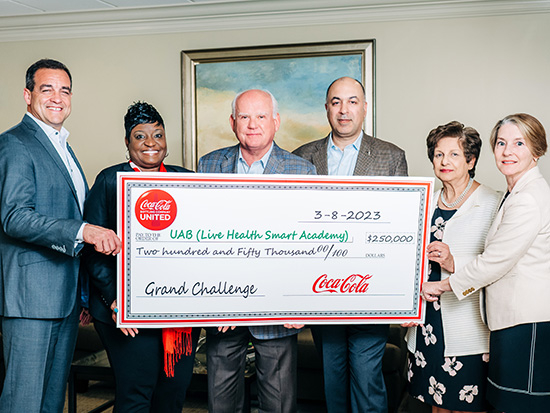 “We have a lot of lives to reach”: $250,000 gift from Coca-Cola UNITED will help Live HealthSmart Alabama launch community leadership academies in underserved communitiesThe Healthy Happy Kids program focuses on a different health and physical activity topic each week, encouraging children to make healthier choices.
 -

-
 Meet the Speaker: Dr. Wayne Giles to give keynote address at upcoming UAB Health Equity Research SymposiumEach April, National Minority Health Month is observed to raise awareness about the health disparities and premature mortality faced by racial and ethnic minority groups. The conversations had during this month not only shine a light on the important work being done to improve the health and wellness of these groups but also helps shape the policies, systems, and environments that can reduce such disparities to create health equity. As the UAB Minority Health & Health Equity Research Center commemorates this year’s National Minority Health Month, we prepare for the 16th UAB Health Equity Research Symposium (HERS)—the first in person since 2019. Formerly known as the Health Disparities Research Symposium, HERS is a day-long event comprised of poster sessions, oral presentations, and a keynote speaker.
 -
 Mona Fouad, M.D., MPH accepts Vilcek-Gold Award and presents on compassion and resilience at the AAMC conferenceOn Saturday, November 12, 2022, Mona Fouad, M.D., MPH— Associate Vice President for UAB Diversity, Equity, and Inclusion, Senior Associate Dean for Heersink School of Medicine Office for Diversity and Inclusion, and Director of the UAB Minority Health & Health Equity Research Center—accepted the Vilcek-Gold Award for Humanism in Healthcare at the Association of American Medical Colleges (AAMC) annual conference in Nashville, TN.
 -
 2022 UAB Health Disparities Research Symposium Recap and Full RecordingThe UAB Minority Health & Health Equity Research Center hosted its annual UAB Health Disparities Research Symposium on Thursday, September 8, 2022. The virtual symposium was part of the Center's 20th Anniversary, celebrated throughout September. The session, which was moderated by Regina Benjamin, M.D., 18th United States surgeon general, included the following panelists:
 -
 UAB Minority Health & Health Disparities Research Center Celebrates its 20th anniversary with a new name and month-long programmingThere have long been significant differences in health across race, income, education, and geographic location. In Alabama and in the Deep South, the impact of these differences is seen everywhere, from the state’s largest cities to most rural areas. For 20 years, the UAB Minority Health & Health Disparities research center has taken a comprehensive, science-first approach to improve the health of people in historically under-resourced areas—with efforts in research, training, and community engagement.
 -
 FIRST partnership begins recruitmentIn November 2021, the University of Alabama at Birmingham and Tuskegee University received a first of its kind $13.7 million grant to further inclusive excellence in research across both institutions. As part of that effort, the program is now recruiting 12 new early career research faculty members.